- About
- Somatic Movement Research
Somatic Movement Research
Somatic Movement Studies
The word soma was reinvented by Thomas Hanna, teacher of the Feldenkrais Method and editor of Somatics magazine, who distinguishes between the concepts of body and soma: “(…) soma is the subjective body, that is, the body perceived from the individual’s point of view. When a human being is observed from the outside, for example from the point of view of a 3rd person, then it is the body that is perceived. ” (2003) Somatic Education emerges from an evolutionary process that is built on the basis of experiential research. Bodily experience is at the heart of this new paradigm.
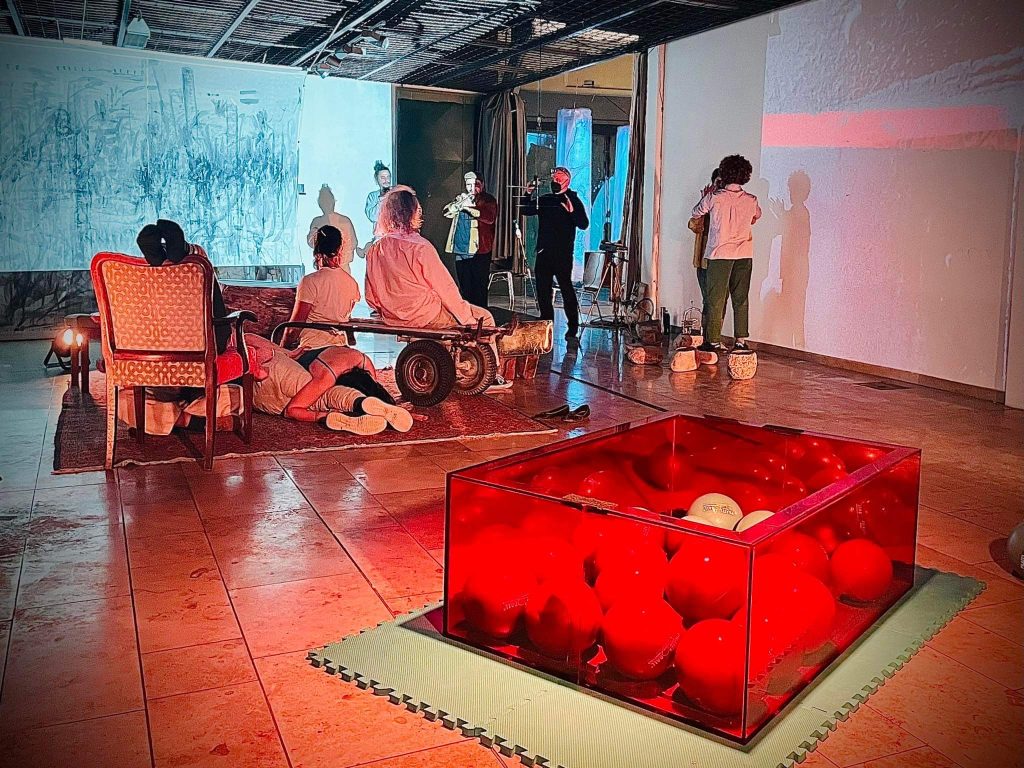
Dance and the contemporary performance scene
Contemporary dance and dance theater have always gone hand in hand in the German performance scene.
I like the way dance critic Jochen Schmidt describes the direction in which dance theater is developing in our time. He explains:
“Dance is discovering an interest in people and their innermost motivations… “It raises questions:
What is this human being who becomes the subject of this dance research? A living, political body that is ready to transform beliefs and paradigms, to break the expectations of the forms and shapes imposed by a socio-economic system?
A living body, 80% fluid, full of organs, nerves, muscles, arteries, joints and bones, speaks for itself. It finds within itself the statement and the message it wants to convey.
Contemporary dance therefore gives this body space. It lets the body speak and wants to listen to it. From a place where fluids and tissues develop their own homeostatic dance. From an anatomy that remains hidden to the eye.
A human being, a body, an anatomy are themselves active and receptive to the various states of the mind and in a constant exchange between seemingly “utopian” (i.e. invisible) intermediate worlds and a seemingly real outside world.
Contemporary dance embraces this utopian dimension of the mind when it decides to incorporate the states of this mind into its movements and narratives.
As the French philosopher Michael Foucault reminds us in his ideas about the utopian body:
How can we recognize the invisible parts of the body as real? Our own back perhaps through a mirror or a camera, another’s body through the autopsy of a corpse.
Contemporary dance also explores this utopian, invisible body. Without necessarily having to dissect a corpse. It builds a bridge between the unknown of art perceived through the retina and our own body consciousness, which also perceives, feels and reacts to art. It is about appreciating the body systems in a micro and macro context and creating and receiving art from there.
A seemingly utopian body becomes an inspiring object of research and narrative through dance and movement. From a social perspective, such dance research deconstructs notions of contact, exchange, communication, gaze, response and all the infinite aspects that can be experienced in the encounter of the body in space, in time, in the encounter of the body with the mind and with the other body.
An uninterrupted exchange between the triad of space, mind and body. A place of renunciation of any preconceived control that we impose on ourselves in the production and consumption of art when we surrender to this perceptive body-mind-space system.
An art that is not utopian, but immanent. Immanent, ephemeral, heavy, tough, confusing, but also elegant, fleeting, permeable, adaptable, transversal, dual, reciprocal, complex and timeless.
An immanent body of attentive, alert gazes. Guided by an awareness of what these gazes trigger in what they see. And what they receive when they see? The immanence of the interaction between the parts. The embodiment of exchange. The awareness of a constant adaptation between the participants in the moment of producing and experiencing art.art that depicts, incorporates and serves the immanence of the life of a living body!
Yahsmine Lamar